
Technical context
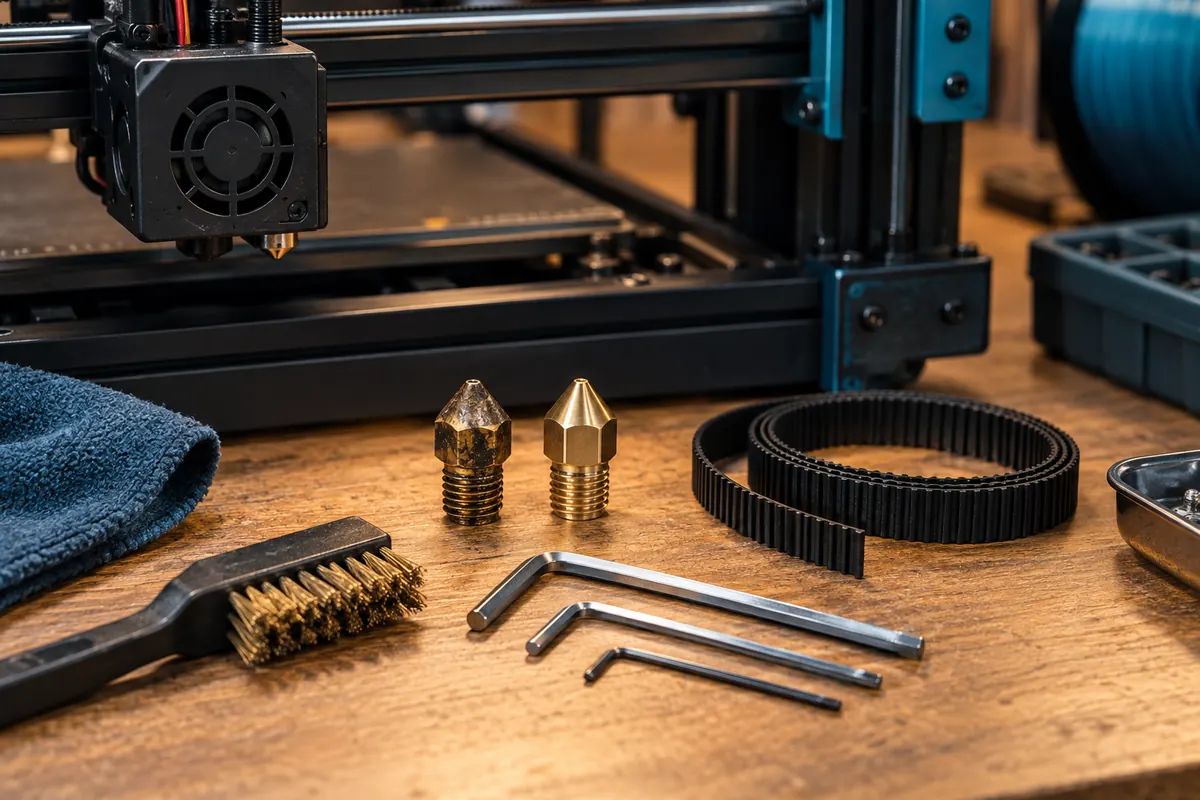
Keep a log of nozzles, sheets, belts, lubricants and labor under the manufacturer's actual service procedure. Allocate recurring expenses across productive hours or jobs, declaring the basis. Some components wear with abrasive material use rather than elapsed calendar time.
Annual maintenance budget example
View data table
| Comparison | € |
|---|---|
| Parts | 60 |
| Service labor | 60 |
| Total | 120 |
Practical workflow
A yearly 120 maintenance budget over 600 productive hours implies 0.20/h. If utilization falls to 300 hours, the same budget implies 0.40/h. This is a planning allocation, not a guarantee of lifetime or a substitute for actual service records.
Calculation and units
Hourly depreciation = (purchase ? residual)/productive lifetime hours. Productive annual hours = available hours × utilization. Keep maintenance separate.
Worked example
900 purchase, 100 residual and 4,000 productive hours give 0.20/h. Ten print hours carry 2.00. Halving lifetime productive hours doubles the rate.
Validate the outcome
Review utilization quarterly. Do not recover the same capital through both fixed annual overhead and a second variable capital rate.
Build the budget from your own service record
Maintenance covers recurring inspection, cleaning, adjustments and replacement work needed to keep the machine reliable. It is separate from electricity and the allocation of purchase cost through depreciation. Start with actual parts, consumables and active service time rather than borrowing a claimed universal hourly rate. Record which printer and operating period the costs belong to. A fleet with different machines may need separate rates, especially when abrasive materials or distinct operating conditions change the service workload.
Separate scheduled work from repair events
Routine service is performed according to a machine's documented guidance and observed condition. An unexpected failure adds diagnosis, replacement, downtime and potentially lost prints. Keep those categories visible so one costly event does not disappear inside an unexplained average. Follow procedures for the particular machine rather than applying lubricant or replacing parts on an invented universal schedule. A maintenance plan should make work traceable and correctly assigned, not imply that every component must be replaced at a fixed number of printing hours.
Include active labor without confusing machine time
Count the time actually spent inspecting, servicing, testing and returning the printer to usable condition. Four hours of machine downtime may include only thirty minutes of hands-on labor, and the two have different cost meanings. Active labor can be priced at a justified internal rate. Downtime may constrain capacity or cause an opportunity cost, but it should not automatically be charged again as labor. Document the chosen accounting basis so comparisons across machines or periods use the same definitions.
A transparent hourly allocation
Suppose a defined period contains 80 of service parts and consumables plus three active hours valued at 20 per hour. Total recorded maintenance is 140. If the corresponding printer operated 700 print hours, the allocated rate is 140 / 700 = 0.20 per operating hour. A five-hour print receives 1.00 by this model. These values are an illustrative calculation, not an industry rate. The result changes when costs or the operating-hour basis changes, so retain both numerator and denominator rather than only the final number.
Avoid charging the same cost twice
If a combined machine rate already includes maintenance, adding a separate maintenance line duplicates it. The same issue arises when a service labor cost is counted in both the maintenance budget and job labor. Decide which category owns the contribution and apply that rule consistently. Depreciation covers allocated acquisition value, while maintenance covers the selected service work; a replacement that is treated as a capital upgrade may need another accounting basis. For formal tax or financial reporting, use the relevant professional requirements rather than treating this planning model as official accounting.
Measure reliability alongside spending
A low maintenance spend can look attractive while failures, quality drift or downtime become expensive. Record accepted operating time, faults and repeat work alongside service cost. A replacement that costs more may reduce disruption, but that benefit must be observed rather than invented. Compare before and after periods under similar use. Use the failed-print calculator for documented loss assumptions and the farm tool for capacity consequences. Do not count an uncertain reliability improvement as guaranteed revenue merely because a service action was performed.
Plan stock and review the rate
Keep a practical list of compatible replacement items and their recorded lead times when availability matters. Excess stock has its own cost, while no stock can extend a disruption. Review the allocation periodically using a defined set of operating hours and actual service work. A short period with one major repair can distort the average; state that limitation when quoting. Save maintenance history with printer profiles so the cost tool uses a justified rate. Update it after major hardware changes rather than preserving an old number whose basis no longer matches the machine.
Is maintenance the same as depreciation?
No. Acquisition allocation and recurring service spending are separate categories; avoid including both twice in a combined rate.
Can I use one hourly value permanently?
Review it using actual service costs and a defined operating-hour basis, especially after major changes.