
Technical context
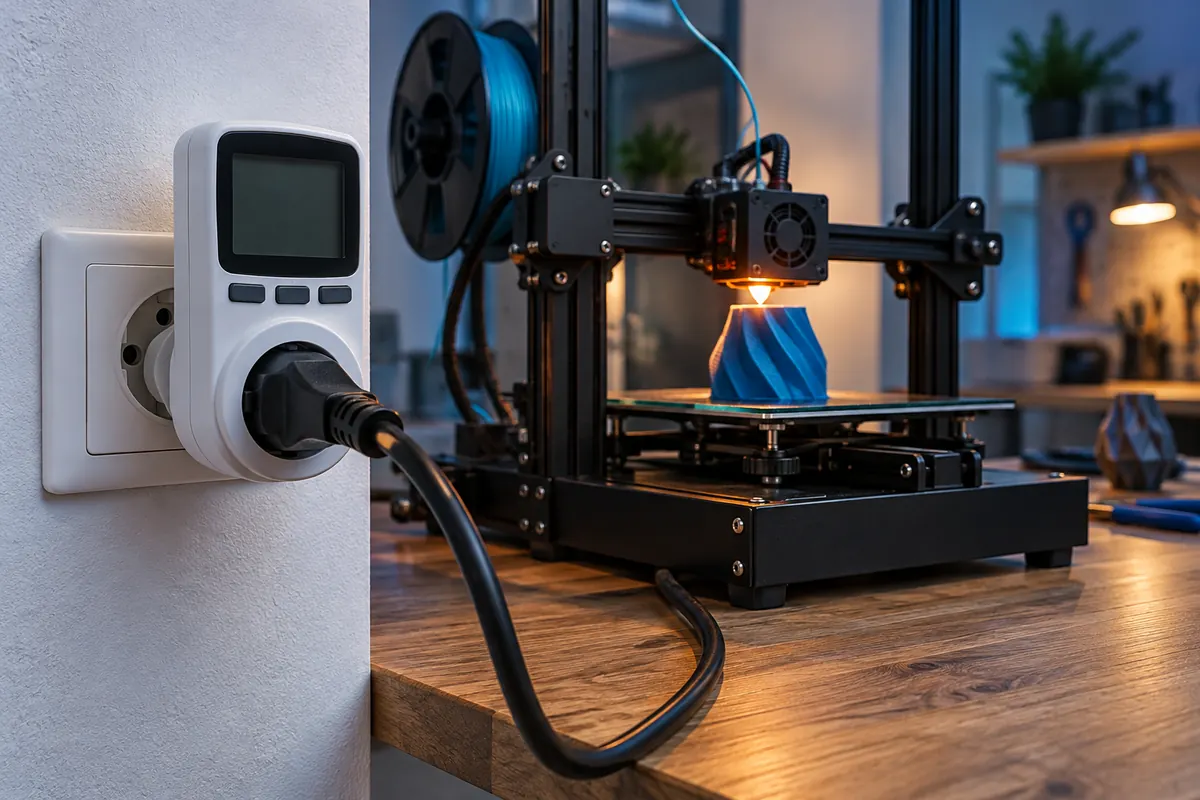
Measure a representative print from preheat to completion with an energy meter appropriate for the supply. Note material, bed temperature, enclosure and room conditions. Repeat for materially different profiles instead of assigning one universal number to a printer model.
Power consumption over eight hours
View data table
| Comparison | kWh |
|---|---|
| 80 W | 0.64 |
| 120 W | 0.96 |
| 200 W | 1.6 |
Practical workflow
A taller part may use less energy per layer yet run for more hours. A hotter enclosed material may increase heating demand but change cooling losses. Compare measured kWh per accepted job and keep dryers or post-curing equipment in explicit separate categories.
Calculation and units
Energy kWh = average W × hours/1000; cost = kWh × tariff. Include preheating only when the measurement scope includes it.
Worked example
150 W for eight hours = 1.2 kWh, costing 0.36 at 0.30/kWh. A 50 W dryer for four hours adds 0.2 kWh and 0.06.
Validate the outcome
Measure representative jobs rather than a single moment. Budget standby separately and do not mix watts with kilowatts.
Measure energy at the correct boundary
A meter that accumulates kWh over the whole cycle captures heater switching better than a photograph of instantaneous watts. Record whether the cycle begins before preheating and ends when motion stops, after cooldown or after automatic power-off. Different boundaries produce different numbers even with identical printing behavior. Use one convention for repeat comparisons.
For a monthly workshop budget, add idle periods and separate accessories if they are outside the print measurement. Filament dryers, enclosure heaters, extraction and resin washing or curing equipment may consume energy while the printer is inactive. Include only equipment actually used and avoid charging an accessory twice if the meter already measures the shared outlet.
An eight-hour job with two stages
Suppose measured preheating uses 0.06 kWh and the following eight-hour print averages 120 W. Printing energy is 0.96 kWh and total measured-cycle energy is 1.02 kWh. At 0.30 per kWh the total is 0.306. Treating the 350 W supply capacity as constant for all eight hours would instead claim 2.8 kWh before preheat, a very different unsupported estimate.
The average can be obtained from measured energy: 0.96 kWh times 1,000 divided by eight hours gives 120 W. It belongs to that profile and environment. Use it as a starting estimate for similar jobs, then validate it for hotter bed settings or a substantially different room temperature.
Compare efficiency per accepted result
Reducing print hours can lower energy, but comparing only instantaneous wattage can reward a slower process that consumes more total energy. A machine averaging 100 W for ten hours uses 1 kWh; one averaging 150 W for five hours uses 0.75 kWh. The higher average power can therefore still deliver the lower total under these hypothetical conditions.
Include yield. If a low-energy profile repeatedly fails or produces unusable bonding, its kWh per accepted unit may be worse than a stable profile. Monitor energy together with quality, consumption and time, and consider changes to whole-job geometry before trying to lower necessary process temperatures merely to save electricity.
Whole-cycle energy example
| Stage | Energy | At 0.30/kWh |
|---|---|---|
| Preheat | 0.06 kWh | 0.018 |
| Eight-hour print at120 W | 0.96 kWh | 0.288 |
| Complete cycle | 1.02 kWh | 0.306 |
Translate a meter reading into a profile estimate
If a completed printing stage consumes 0.96 kWh over eight hours, its average is 120 W. Use that value only for comparable conditions, not as a universal printer rating. State whether preheat and accessories are included. For a different bed temperature or room environment, repeat measurement. Compare total accepted-job kWh rather than a single low instantaneous wattage, and retain the meter boundary in your production record.
Can I use the supply rating if I have no meter?
It can form an explicitly labeled rough upper capacity reference, but it should not be presented as average consumption. Heating cycles and load vary, and the rating describes what the supply can deliver. A manufacturer measurement matching your profile is a better estimate than capacity alone, while a whole-job meter measurement is more directly relevant. Show the input as assumed until verified.
Does a faster print always use less electricity?
Not necessarily. A faster process may change average heater demand, cooling or startup overhead. Calculate or measure total kWh for the completed accepted job. Under otherwise similar conditions less time can reduce energy, but the energy meter, not the requested speed number, settles the comparison. Include any rejected fast prints if assessing production efficiency rather than one successful trial.