
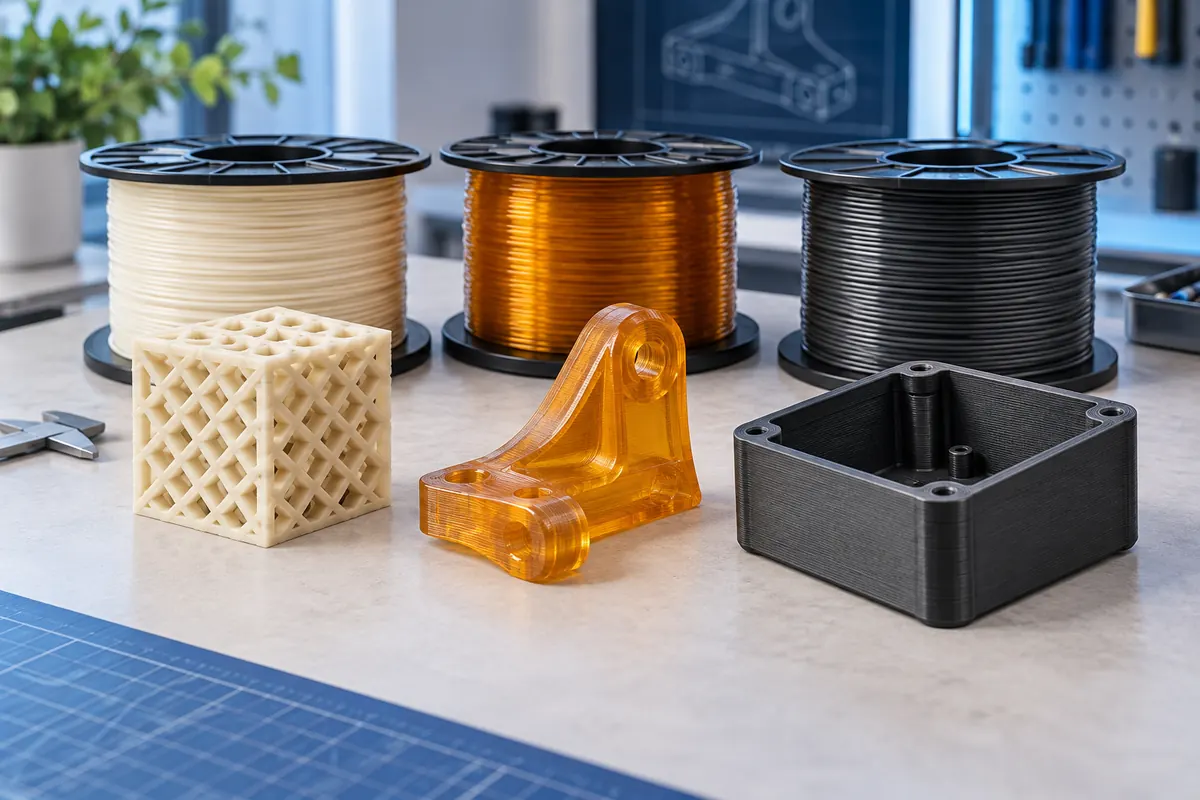
Technical context
PLA is often convenient for prototypes and visual models; PETG is often selected for tougher functional use; ABS is commonly considered where higher-temperature use and post-processing justify more demanding printing. These are selection tendencies, not certifications for every formulation or application.
Practical workflow
Compare exact technical and safety datasheets and print representative specimens. A manufacturer tensile value may come from a molded specimen and cannot be directly treated as strength across printed layers. Price per kilogram also ignores supports, failure rate and finishing.
Calculation and units
Mass g = cm³ × density g/cm³; volume = mass/density. 1 cm³ = 1 mL = 1,000 mm³.
Worked example
20 solid cm³ at 1.24 g/cm³ weigh 24.8 g. A 20% infill print is not automatically 20% of that because walls remain.
Validate the outcome
Mark generic presets as estimates. Printed apparent density includes voids and is different from raw polymer density.
Begin with a service-condition checklist
Write down the part's expected temperature, loading mode, impact exposure, contact conditions and appearance requirements. An indoor display object, a bracket near a heat source and a repeatedly flexed clip are different engineering tasks. Avoid choosing a polymer solely because its name sounds stronger. Stiffness, toughness and temperature resistance are distinct properties; a rigid specimen can still be brittle under impact or unsuitable for sustained load.
The specific grade matters. Reinforcements, pigments and additives change printing behavior and mechanical properties. Compare datasheets with compatible test methods and distinguish molded specimens from printed ones. A datasheet value is meaningful only within its stated test conditions; it does not automatically establish your layer-bond strength or final assembly performance.
Printing suitability is part of material selection
A material that theoretically meets the service requirement is not useful if your machine cannot process it reliably. Consider the supported temperatures, build-surface compatibility, enclosure requirements and material handling. Follow the printer and filament manufacturers' procedures rather than transferring one brand's recommended settings to every blend with the same polymer name.
For visual prototypes, start with a supported profile and evaluate detail, surface and post-processing. For functional use, print a representative geometry in the intended orientation and test the relevant loading condition. This is particularly important across layers, where deposition creates direction-dependent performance. Keep notes on profile, conditioning and failures so the comparison can be repeated.
Compare cost per accepted function
Suppose material A costs 25/kg and a job consumes 100 g, while material B costs 30/kg and consumes the same mass. The direct material difference is only 0.50. If B reduces twenty minutes of finishing or prevents a reprint, its accepted-part cost can be lower despite the higher spool price. Conversely, a material change that requires more supports or longer handling can cost more than its nominal price suggests.
Use the cost tools to quantify these categories and keep property selection separate from cost minimization. None of the three polymer names alone establishes suitability for food contact, outdoor life, elevated-temperature service or safety-critical loading. Those uses require product-specific evidence and an appropriate validation process.
Selection questions before choosing a polymer
| Requirement | Evidence to inspect |
|---|---|
| Service temperature | Exact grade datasheet and representative use |
| Impact or flexing | Relevant test and printed orientation |
| Manufacturability | Supported printer and material profile |
| Accepted cost | Consumption yield and active labor |
A functional comparison needs controlled specimens
Print comparable specimens in the intended orientation and evaluate the relevant behavior, not merely which surface looks better. Record whether the task requires stiffness, impact survival, warm service or repeated flexing. Use exact grade datasheets as background and keep your own observations separate from manufacturer tests. A cost comparison should include accepted yield and finishing. No generic polymer name establishes certification for food contact or safety-critical use.
Which material is strongest?
There is no useful universal answer without a loading mode, temperature, geometry and print orientation. Tensile strength, stiffness, impact resistance and resistance to sustained deformation are different properties. Compare exact grades and validate the feature that matters for the part. A material winning one datasheet test may be less suitable for a snap fit or a warm loaded bracket.
Can I transfer the same settings between PLA and PETG?
Begin from a supported profile for each product instead. Temperature, cooling, adhesion, flow and handling can differ. Record the nozzle, surface and filament grade and run an appropriate small verification print. Similar-looking filament or a successful previous PLA job does not prove the PETG profile, and cost comparisons should use each material's actual sliced consumption and accepted yield.