
Technical context
Use the value for the exact product, with the manufacturer's units and measurement conditions. A generic PLA preset is only a working assumption for another PLA blend. Filled and lightweight foaming grades are especially unsuitable for unqualified substitutions.
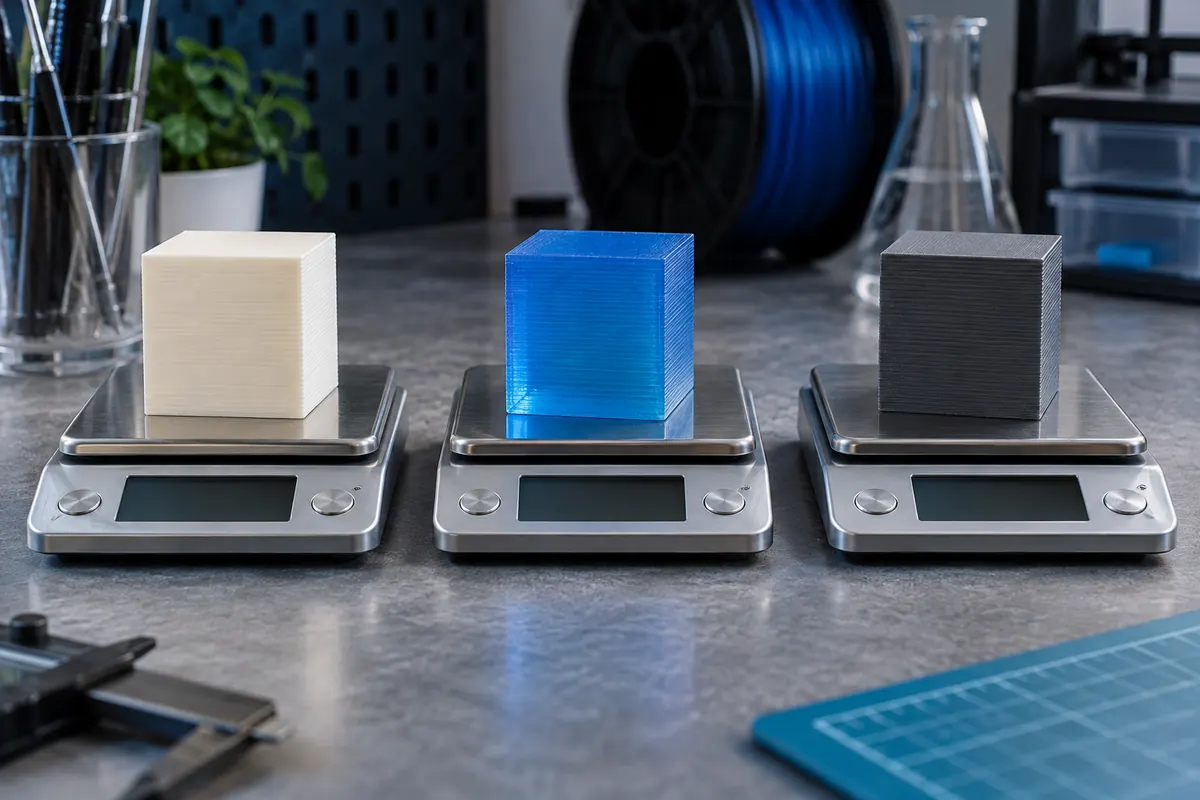
Density changes the mass
View data table
| Comparison | g |
|---|---|
| 1.00 g/cm³ | 10 |
| 1.20 g/cm³ | 12 |
| 1.40 g/cm³ | 14 |
Practical workflow
Distinguish raw material density from apparent printed density. A hollow 30 g part occupying 100 cm³ externally does not establish a polymer density of 0.30 g/cm³. It establishes an average for that printed structure including air, which answers a different question.
Calculation and units
Mass g = cm³ × density g/cm³; volume = mass/density. 1 cm³ = 1 mL = 1,000 mm³.
Worked example
20 solid cm³ at 1.24 g/cm³ weigh 24.8 g. A 20% infill print is not automatically 20% of that because walls remain.
Validate the outcome
Mark generic presets as estimates. Printed apparent density includes voids and is different from raw polymer density.
Read the units before using the value
A density reported as 1.24 g/cm³ is numerically equivalent to 1.24 g/mL and 1,240 kg/m³. It is not 1.24 g/mm³. Confusing cubic centimeters and cubic millimeters creates a factor-of-one-thousand error. When converting a mesh volume in mm³ to grams, divide volume by 1,000 before multiplying by g/cm³ density.
Check whether the data describes solid material, bulk pellets or a printed specimen. Bulk density can include air between pellets, while printed apparent density can include designed infill voids. Neither should be silently substituted for solid polymer density in a filament strand mass conversion.
How density affects a length-based estimate
For the same diameter and length, calculated mass is directly proportional to density. If the true product density is 1.30 while the profile uses 1.24, the mass estimate is low by about 4.8% relative to the profile value. This hypothetical difference can matter in pricing or near-empty spool planning even though extrusion paths are unchanged.
Diameter uncertainty compounds the issue because area grows with diameter squared. A 1% diameter increase produces about a 2.01% area increase. Keep density and diameter separate in diagnostics: changing an extrusion multiplier to correct a mass-report assumption also changes deposited quantity and can damage an otherwise good process.
Build a traceable material profile
Store the manufacturer, product grade, diameter, density value, source link and verification date in the profile. Mark whether the value came from a technical datasheet, a safety datasheet or a generic estimate. If the supplier changes formulation, review the assumption rather than assuming the old profile remains correct indefinitely.
For an unfamiliar composite, use the supplier's data or an appropriately measured specimen. Do not claim a generic table proves the value for a filled, foaming or proprietary blend. When comparing consumption from different slicers, check their chosen densities first; the same extrusion length can produce different reported grams solely because of metadata assumptions.
Equivalent density units
| Unit | Equivalent example |
|---|---|
| g/cm³ | 1.24 |
| g/mL | 1.24 |
| kg/m³ | 1240 |
| g/mm³ | 0.00124 |
Diagnose report differences without changing deposition
If two slicers report different grams for the same length and diameter, compare their density assumptions before altering flow. At 1.30 instead of 1.24, predicted mass rises about 4.8% while the geometrical strand volume stays unchanged. A separate diameter difference changes area quadratically. Store each assumption with units and source; this allows a report discrepancy to be solved in the relevant profile field rather than perturbing an otherwise successful print.
Does infill change material density?
Infill changes the structure's apparent density by leaving internal space; it does not by itself change the density of the deposited polymer. A part's outer volume divided into its total mass describes the whole structure, including air. Use solid product density for strand conversion and the slicer's generated paths for consumption. Mixing these two interpretations creates misleading estimates.
Is a PLA density preset suitable for every PLA?
It is an estimate for an unspecified product, not a guarantee. Fillers, pigments, blending and foaming can alter density. Prefer the exact technical datasheet, identify units and keep the source date in the material profile. If a generic value is unavoidable, show it as assumed and allow the visitor to enter a verified product-specific value.