
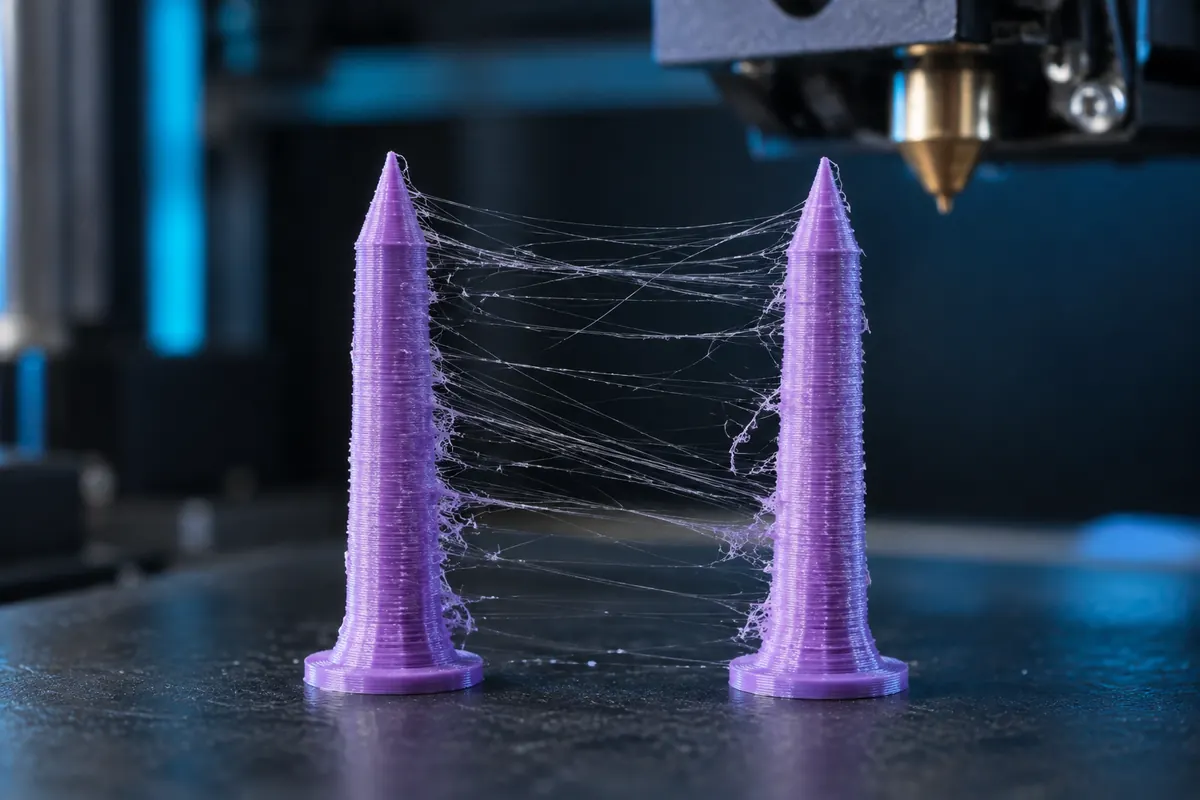
Technical context
Start from the correct manufacturer profile and compare a dry known-good spool. Clean accessible nozzle deposits by the approved method and run a repeatable travel-heavy test. Change temperature within the material's supported range, then examine retraction and travel strategy one parameter at a time.
Practical workflow
Do not copy Bowden retraction distances to an unrelated direct-drive system. Excessive retraction can introduce other feeding problems. Evaluate whether the fix preserves bonding and surface quality; reducing all extrusion to hide strings is not a sound calibration method.
Calculation and units
New ratio = current ratio × target/measured wall. 1.00 means 100%; slicer and firmware multipliers can multiply.
Worked example
1.00 ratio, 0.45 mm target and 0.47 mm measured suggest 0.95745. Reprint and inspect surfaces and dimensions.
Validate the outcome
Measure cooled samples repeatedly. Large corrections may indicate hardware or feed issues instead of a simple flow mismatch.
Document the pattern before changing retraction
Photograph the failed part and identify whether strands occur between separate islands, at seams, across nearly every travel, or only after a long pause. Fine hairs and thick deposits may have different contributing causes. Preserve the file and profile used to make the sample. A generic retraction increase is a poor starting point when no baseline exists. Pick a small test with repeated travel representative of the actual failure, and keep its geometry constant while comparing settings.
Check the material condition and feed path
Use known material in a consistent condition and verify that the spool feeds freely. Popping, rough extrusion or bubbles provide useful observations but do not prove moisture alone. A dirty nozzle exterior or degraded residue can also leave deposits. Follow the manufacturer's inspection and cleaning procedure rather than adding an arbitrary flow correction. If filament condition is suspect, use an appropriate documented drying process and compare the same test again. Fixing the feed path gives retraction experiments a stable basis.
Treat temperature as a controlled experiment
Choose temperatures within the material and printer's supported operating guidance. Change one setting and compare strands, surface quality and bonding rather than judging only the absence of hairs. A lower temperature may reduce one visible symptom while introducing weak layers or under-extrusion. Keep speed and material throughput comparable during the test. The best setting is not the coldest number that looks clean on a tiny sample; it must support the intended part and print conditions.
Retraction must match the extrusion system
Direct-drive and remote-drive paths can respond differently, and a value from another machine should not be copied without context. Use the manufacturer's or profile's starting procedure and make bounded changes. Excessive retraction can create delayed restart, grinding or another feed problem. Record distance and speed separately because changing both at once hides which factor helped. If travel strands improve but gaps appear after every restart, the correction has traded one defect for another and needs reconsideration.
Travel strategy can reduce opportunities for ooze
Inspect where the slicer places non-extruding movements. A different route may avoid crossing exposed surfaces, but a longer travel can also change the time available for material to ooze. Do not assume a checkbox eliminates every strand. Compare preview and printed sample while leaving temperature and retraction fixed. Z movements and seam placement can alter visible defects, so document those settings. A successful travel revision should retain dimensions and reliable restarts as well as improve appearance.
Validate on the actual geometry
A two-post calibration can locate a useful range, but the production model may include longer travels, more islands or a different flow demand. Reprint the relevant region or a representative part with the candidate settings. Compare total time and any new surface gaps before saving the profile. Keep a short log with changed variable, result and conclusion; ineffective changes can then be reversed. Clean remaining cosmetic strands only after solving the repeatable process cause, and do not mistake post-processing for proof that the extrusion settings are correct.
Should I always increase retraction first?
No. Establish a baseline and check material, feed path and temperature. Excessive retraction can create restart defects.
Does a clean small test guarantee a clean production part?
No. Validate with the actual travel pattern, islands and flow demand of the intended geometry.